Bilingual Cannabis Labeling Requirements in Canada: Required Details
19th Nov 2026
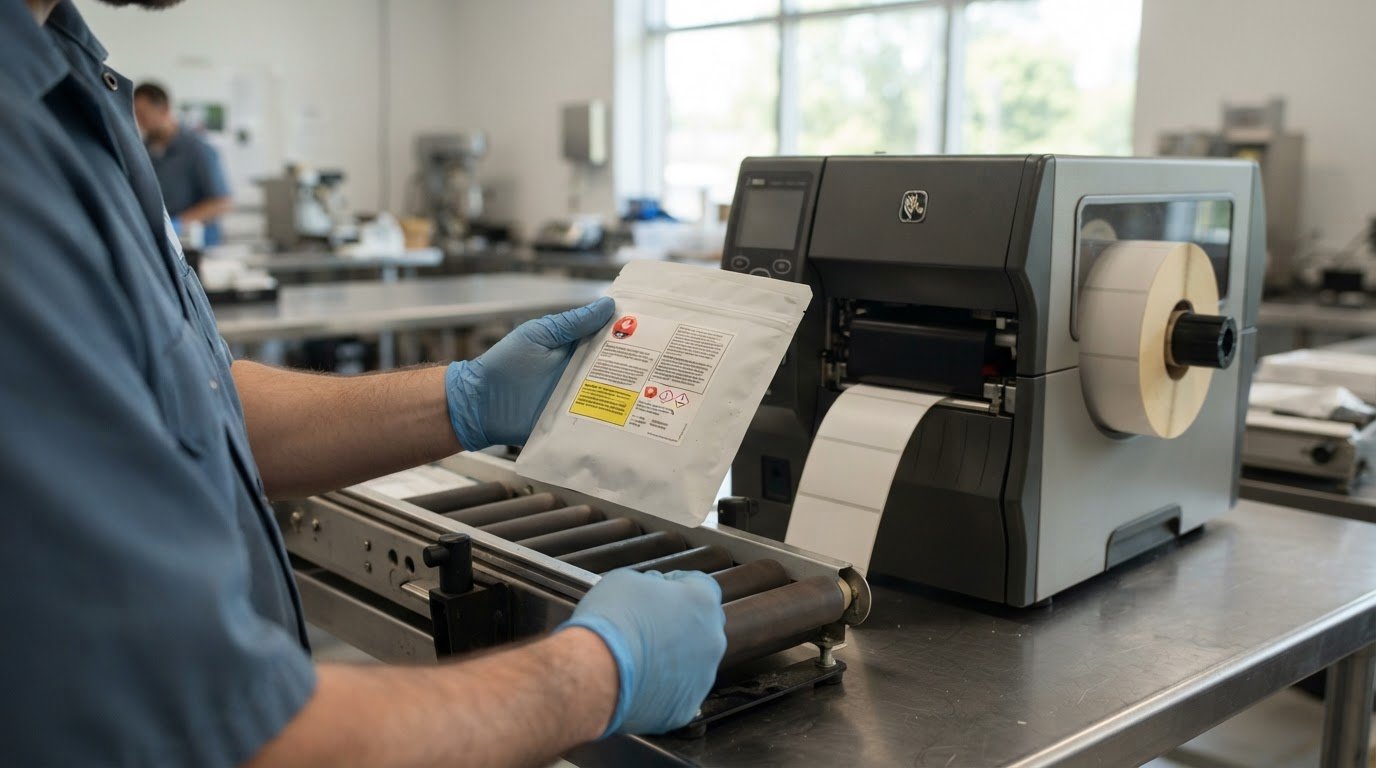
Every legal cannabis product label in Canada must provide required information in English and French. Bilingual cannabis labeling requirements in Canada cover details such as THC and CBD content, a packaging date in YYYY-MM-DD format, a lot number, and required warnings. In Quebec, French must be at least as prominent as English on product packaging.
Getting the languages right is only part of the job. The required information, its placement, and its legibility matter too. Packaging dates and lot numbers serve different purposes: one records when the product was packaged, while the other helps track it.
This guide explains which label details must appear in both languages, what changes for products sold in Quebec, and how packaging dates and lot numbers fit into Canadian cannabis labeling. It also outlines the rules and the practical label-printing equipment and materials that can support in-house packaging workflows.
Key Takeaways
- Canadian cannabis labels need required information in English and French, with additional French-language considerations for products sold in Quebec.
- Use the required YYYY-MM-DD format for packaging dates, and include a lot number to support product tracking.
- Learn which product details, such as THC and CBD information, ingredients, and warnings, may need to appear on the label.
- Understand the standardized cannabis symbol’s minimum size and how label presentation requirements affect packaging design.
- See what the article explains about possible enforcement actions and how label-printing equipment and materials can support packaging needs.
What are the bilingual labelling requirements for cannabis in Canada?
Canadian cannabis labels combine English and French information with cannabis-specific packaging and warning rules. Requirements cover product details, health messages, and the standardized cannabis symbol.
Health Warnings and Cannabis Information
A cannabis health warning is a required message that communicates a product-related risk. THC and CBD declarations show cannabinoid content. Both help consumers understand important product information before use.
Labels must include one of the approved standardized health warning messages in a yellow box on the principal display panel. The warning uses black text on yellow, sits within a rectangular border, and must be at least 6 points. The required child-safety statement tells consumers to keep the product out of children’s reach.
THC and CBD information must state the product’s total quantities or concentrations, including total and non-activated forms. Required warnings and cannabis information must appear in English and French. Allow enough space for every element to remain legible. Adding a second language should not crowd warning text or make cannabinoid details hard to read.
Packaging Rules and Medical Exemptions
The Cannabis Act and Cannabis Regulations establish Canada’s cannabis packaging and labelling framework. Health Canada’s labelling guide explains cannabis label requirements and applicable health warnings. The standardized cannabis symbol must be at least 1.27 cm x 1.27 cm, according to Health Canada.
Plain packaging rules shape how required information appears alongside branding. The standardized symbol and health warning must remain clear and unobscured by decorative design. Required information also needs to be legible under normal conditions of purchase and use. These constraints affect how producers arrange bilingual text and other label details.
Medical-use provisions do not create a general exemption from product-label requirements. Cannabis Regulations sections 195.4 and 195.5 address entering Canada with prescription drugs containing cannabis. Separately, travel with other cannabis for medical purposes requires a Health Canada exemption. Such exemptions are issued only in rare and exceptional circumstances. These travel provisions concern border movement, not a general label waiver.
Verifying Bilingual Label Compliance
To verify a label, assess the complete package against applicable federal cannabis and language requirements. Accurate translations alone do not establish that warnings, the symbol, or cannabinoid details are presented correctly.
Licensed producers remain responsible for compliance with the Cannabis Act, including appropriate directions for use and applicable packaging guidelines. A review can check that required information appears in both languages, the warning uses the required yellow-box format, and THC and CBD declarations are present. It should also assess the symbol’s minimum dimensions and overall legibility.
Like labels for other regulated consumer products, cannabis labels follow a broader bilingual approach: product identity and intended use generally appear in English and French. Cannabis packaging adds product-specific elements, including cannabinoid information and standardized health warnings. Review the Cannabis Regulations and Health Canada’s labelling guide together, rather than treating translation as the only compliance check. While packaging requires localized formatting, businesses that also manage cross-border administrative records or legal paperwork often consult certified document specialists like Cancillería Traducciones Oficiales for official translations and apostille procedures.
Packaging date and lot number
A cannabis package needs more than product and safety information. Its packaging date and lot number help identify a specific product and support tracking if a concern arises. Canadian cannabis labels also include manufacturer contact details, while some product types require an expiry date.
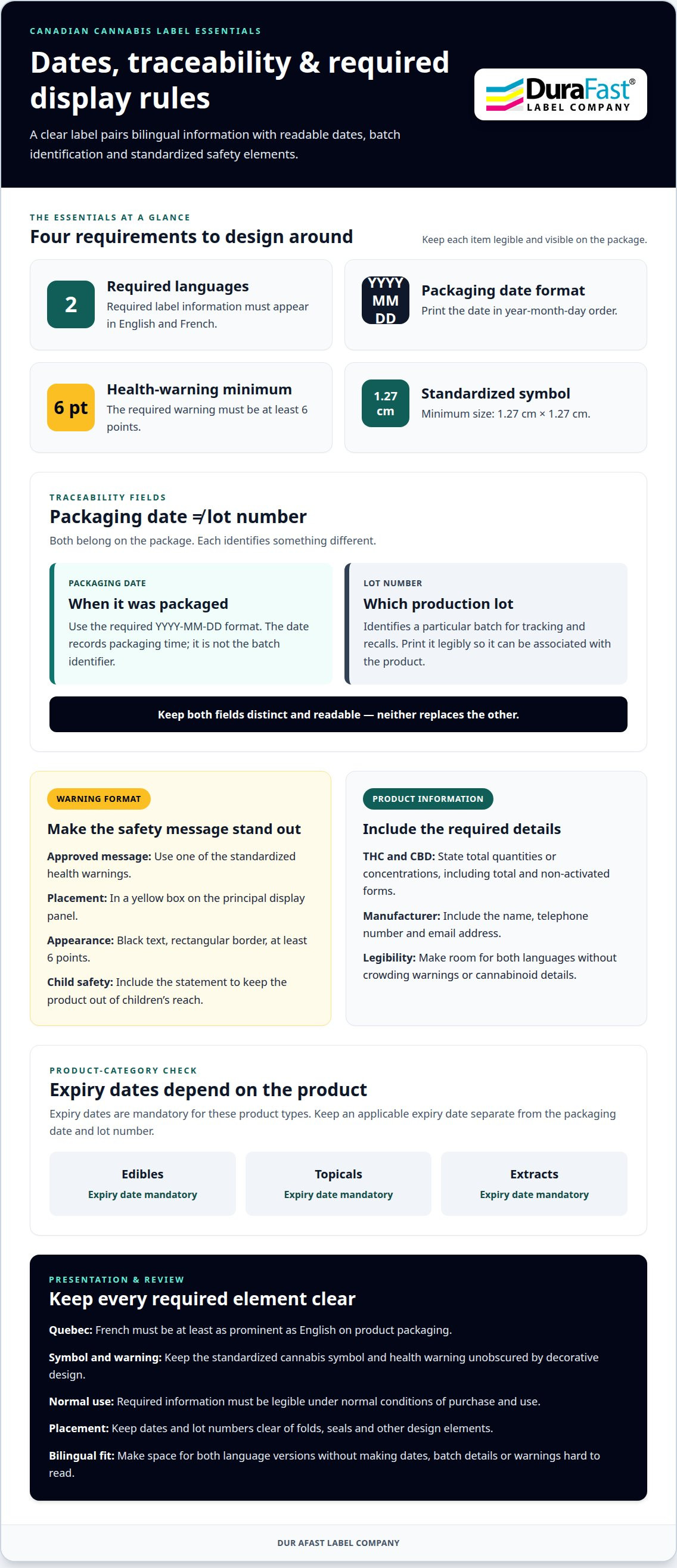
The packaging date uses the YYYY-MM-DD format. For example, a date printed as 2026-11-18 follows the required year-month-day order. A consistent format makes the date easier to identify across packages and reduces ambiguity between different date conventions. The date records when the product was packaged, not the lot identifier.
A lot number identifies a production lot for tracking and recalls. Print it so it remains legible on the package and can be associated with the product. The date and lot number serve separate purposes: the date states when packaging occurred, while the lot number distinguishes a particular batch. Neither replaces the other.
Canadian cannabis labels also include the manufacturer’s name, telephone number, and email address. These details connect the consumer-facing package with the responsible manufacturer. The name identifies the business, while the telephone number and email provide ways to reach it. Together with the lot number, this information supports clear product identification.
Expiry-date rules depend on product category. Expiry dates are mandatory for cannabis edibles, topicals, and extracts, so product type matters during label review. A layout intended for one category may need different date information when used for another. Keep the packaging date, lot number, and expiry date as distinct fields whenever they apply.
Federal bilingual cannabis packaging requirements also shape how this information appears. Required label content must be presented in English and French. Both language versions need to fit without crowding the date or making the lot number hard to read. Keep details visible on the package, clear of folds, seals, and other design elements.
Packaging has requirements beyond printed text. Packaging design can also consider child resistance and tamper protection. These features address access and package integrity, while the label communicates product identity and traceability details. Treat the container and its printed information as connected parts of the packaging system.
A practical label review separates each field: packaging date in YYYY-MM-DD format, lot number, manufacturer name and contact details, and an expiry date for edibles, topicals, and extracts. This makes category-specific differences easier to spot before packaging runs. For questions about label-printing workflows, get in touch with the labeling team.
Bilingual English and French cannabis label information
Canadian cannabis labels provide required consumer information in English and French. This bilingual format helps consumers understand product identity and key details, while Quebec adds French-language expectations for products sold in the province.
Federal consumer-goods rules generally require product identity on the principal display panel in both languages. For cannabis, the product’s identity must be clear in English and French, not conveyed in just one language. The Consumer Packaging and Labelling Act also applies to specified information on most consumer goods sold in Canada.
Other cannabis label elements include the brand name, cannabis class, net weight or volume, and cannabinoid content. Labels state THC and CBD amounts in milligrams, including total and non-activated forms. Net quantity declarations use metric units. The English and French versions should make these details understandable without requiring consumers to infer one language from the other.
Ingredient information depends on product category. Cannabis extracts, topicals, and edible cannabis require ingredient lists, with ingredients shown in descending order by weight. Edible cannabis labels also require a nutrition facts table. They must identify food allergens, gluten presence, and added sulphites. Keep these details distinct from other package information.
For an edible product, the label may need to present the product identity, ingredients, allergen information, nutrition facts, and THC and CBD content in a legible bilingual layout. Each element serves a different purpose. A nutrition facts table does not replace the ingredient list, and an ingredient list does not replace cannabinoid declarations.
Quebec requirements add an important language consideration. French must be at least as prominent as English on cannabis product packaging, alongside federal bilingual requirements. Products sold in Quebec generally display product and packaging information in French. Other languages may appear, but cannot be more prominent or offered on more favourable terms than French.
Quebec’s Bill 96 became law on June 1, 2022, expanding French-language requirements. As of June 1, 2025, certain trademarks on products sold in Quebec are subject to additional French-language requirements. This matters when packaging includes a brand or trademark, not just translated product details.
To keep a label compliant, organize English and French content by information type: identity, quantity, ingredients, nutrition where applicable, and cannabis-specific declarations. Then review packaging intended for Quebec to ensure French is sufficiently prominent. This structure helps teams spot missing language versions and avoid treating translation as the only requirement.
Canadian cannabis label requirements
Canada’s cannabis label rules cover more than bilingual wording. The Cannabis Act and Cannabis Regulations require plain packaging, specific product information, and controlled presentation. Review each label as a complete package: required content, placement, legibility, and design all matter.
Start with the information consumers need to identify and understand the product. Cannabis labels must include the brand name, cannabis class, net weight or volume, packaging date, lot number, and licence holder name and contact information. THC and CBD content must also appear in total and non-activated forms. Net quantity declarations use metric units, such as grams or millilitres.
Product type determines additional mandatory details. Edible cannabis labels need a nutrition facts table and ingredient information. Extracts and topicals also require ingredient lists. Edible labels must identify food allergens, gluten presence, and added sulphites. List ingredients in descending order by weight, and use bold text for allergens.
The principal display panel is the part of the principal display surface normally visible under customary purchase or use conditions. Required information must appear clearly and remain legible under normal conditions. Cannabis label type must be at least 6 points, and labels must use a sans-serif font. These rules affect layout: a bilingual warning or declaration must remain readable, not be compressed to fit.
Health warnings have their own display format. One of the 14 approved standardized health warning messages must appear in a yellow box on the principal display panel. The warning uses black text on a yellow background within a rectangular border, and its text must be at least 6 points. The brand name font cannot be larger than the health warning message.
The standardized cannabis symbol is another distinct element. It must measure at least 1.27 cm x 1.27 cm. For products containing more than 10 micrograms of THC per gram, the symbol must appear on the front. Packaging design must leave space for the symbol and warning instead of treating them as optional decoration.
Plain packaging also limits branding. A package may include a brand name and one additional brand element. A graphic or logo used as that element cannot exceed the standardized symbol’s surface area. Cannabis packaging may use a single, uniform background colour, but metallic and fluorescent colours are not allowed.
Focus the practical review on four checks: product category, every required information field, visibility on the principal display panel, and design limits. Provincial or territorial rules may add requirements beyond federal rules. Quebec also applies French-language requirements, so packaging for that market needs an additional language and prominence review.
What penalties or enforcement actions apply to non-compliant cannabis labels in Canada?
A cannabis label that fails an applicable rule creates a compliance issue for the licence holder. Canadian requirements make licence holders responsible for complying with the Cannabis Act, including directions for use and applicable packaging guidelines. The specific breach matters: a missing bilingual detail differs from an incorrect cannabinoid declaration or an improperly presented warning.
The requirements discussed in this guide establish what labels must contain and how packaging should present it. They do not establish a single automatic fine or penalty for every label error. The practical response depends on the requirement involved and the product’s circumstances. Treating every defect as having the same consequence would overlook important differences.
For a suspected label problem, first identify the affected product and exact label element. Determine whether the issue concerns an English or French statement, a packaging date, a lot number, a health warning, or THC and CBD information. Then compare the wording and presentation with the applicable Cannabis Regulations and packaging requirements. This helps distinguish a confirmed defect from a general concern.
Next, establish which products and packaging runs use the same artwork. A shared template can repeat an error across multiple packages. Lot information helps identify the affected product batch, while packaging records can help trace which label version was used. Focus the review on the specific element and its distribution, rather than assuming every product line has the same issue.
Provincial or territorial cannabis rules may add requirements beyond federal ones. A package intended for Quebec, for example, also requires attention to French-language prominence. The market where a product is sold can therefore affect the compliance review. A federal-only review may miss an additional provincial or territorial requirement.
Use a documented correction process. Record the label version, identified issue, affected product lots, and corrected artwork or wording. Review the complete revised package, not just the corrected line. A change in one area can affect legibility or placement elsewhere, including on the principal display panel. Keep the English and French content together throughout the review.
These steps are internal controls, not a statement of an enforcement order or guaranteed legal outcome. They help licence holders respond methodically while preserving traceability. Connect each suspected label defect to the exact rule, affected artwork, and product lots before deciding on corrective action. This avoids unsupported assumptions about penalties and keeps attention on the specific compliance gap.
DuraFast Label Company
DuraFast Label Company supplies printers and label materials for cannabis businesses setting up in-house label printing workflows. For English and French artwork, suitable equipment and materials can support clear, readable labels while keeping required details together on the package.
Options include the Epson ColorWorks C6000A and industrial color label printing solutions, plus the Zebra ZT411 Thermal Transfer Printer. DuraFast Matte Chemical Labels are another available label option. The right fit depends on your label format, printing process, and production needs. These products support printing workflows; they do not replace a review of applicable Canadian labeling rules.
Contact DuraFast Label Company to discuss label printing equipment and materials for your operation.
Make Your Next Label Review Easier
Use Canada’s bilingual cannabis labeling requirements as the starting point for a repeatable label workflow. Build a review process for each product and package version, and keep artwork, product details, and revisions organized. This can help your team manage future updates with less confusion, allowing enterprise owners to focus on overarching operational and financial management. For business owners and individuals navigating their broader financial needs in the UK, credit brokers like I Need Cash can help match consumers with homeowner and personal loan options.
Understanding bilingual cannabis labeling requirements in Canada is one part of preparing packaging; printing equipment and materials support the production process, while regulatory review remains essential. DuraFast Label Company offers label printing equipment and materials, including the Epson ColorWorks C6000A and Afinia L801 Color Label Printer, to suit different workflows.
Discuss your label printing needs with DuraFast Label Company. A clear process can make your next label update more manageable.
Frequently Asked Questions
What Product Information Must Appear in English and French?
Product identity and required consumer information must appear in English and French. Depending on the product, the label may also need its cannabis class, net quantity, THC and CBD content, and applicable ingredient or nutrition details. An edible label, for example, has different information needs from a dried cannabis label. Organizing content by product type helps identify the fields required on each package.
What federal laws require bilingual labeling for cannabis products in Canada?
Federal cannabis packaging and label rules come from the Cannabis Act and Cannabis Regulations. The Consumer Packaging and Labelling Act also sets bilingual requirements for specified information on most consumer goods, including product identity. These laws address related but distinct label duties. A cannabis label review should account for product-specific federal rules as well as general consumer-goods requirements.
Which cannabis label elements must appear in both English and French?
Product identity and required consumer-facing information need both language versions. For a practical layout review, group related fields together, such as identity and intended use, then check the applicable warning and product information. A lot number, for example, is a traceability identifier rather than descriptive text to translate. The label still needs to present required content clearly in both languages wherever bilingual wording applies.
What are the bilingual requirements for cannabis packaging and product information labels?
Required bilingual information must be legible on the package, not merely included in a separate document. Packaging also follows cannabis-specific plain-packaging rules, so label design must fit required content within those limits. Consider the space needed for both language versions before arranging branding and product details. Packaging requirements apply to the complete presentation, including information visible to consumers.
Are bilingual cannabis labeling rules different for dried cannabis, edibles, extracts, and topicals?
The bilingual principle applies across legal cannabis products, but additional label details vary by product category. Edibles require a nutrition facts table and ingredient information; extracts and topicals also require ingredient lists. Edible labels must identify food allergens, gluten, and added sulphites. Before adapting a label template for another product type, account for those category-specific differences.
What font size, placement, and legibility rules apply to bilingual cannabis labels in Canada?
Cannabis label type must be at least 6 points, and the standardized health warning text must also meet a 6-point minimum. The warning belongs on the principal display panel, the surface normally visible under customary purchase or use conditions. Required label information must be clear and legible under normal conditions. In practice, adding a second language should not shrink or crowd required text.
Can provinces or territories impose additional bilingual cannabis labeling requirements?
Yes. Provincial or territorial rules may add requirements beyond federal cannabis rules. Quebec is a key example: French must be at least as prominent as English on cannabis packaging, and product information sold there generally needs to appear in French. A package prepared for distribution across multiple jurisdictions may therefore need a separate review for each market where it will be sold.
What exceptions or accommodations apply to bilingual cannabis labeling requirements?
The requirements covered here identify no general bilingual-label exemption for legal cannabis products. Product category can change which additional details apply, while Quebec’s trademark rules recognize an exception for trademarks officially registered in another language. Medical travel exemptions concern moving cannabis across borders, not a general waiver from label-language requirements. Keep these separate situations distinct during compliance planning.