Cold Storage Warehouse Labels for Reliable Adhesion and Scanning
27th Oct 2026
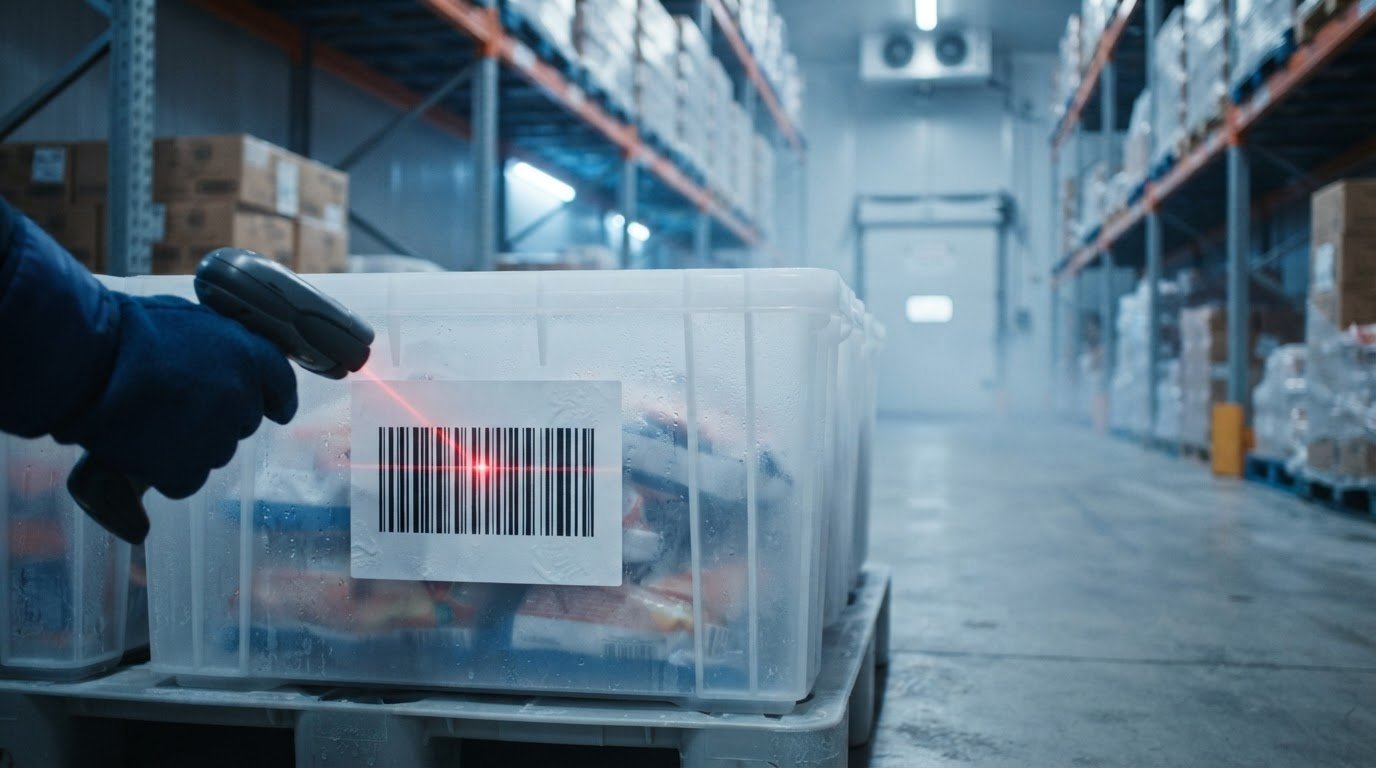
A label that sticks in a refrigerated room may still fail in a freezer. The best labels for a cold storage warehouse pair a moisture-resistant synthetic material with an adhesive suited to the application and storage temperatures, helping keep the label attached and its barcode readable. Refrigerated labels are intended for 32°F to 50°F, while products stored below 0°F call for freezer-grade labels.
This distinction matters because cold can stiffen standard adhesives, while condensation can weaken the bond or blur printed information. The right label depends on the application surface, its temperature, and exposure to moisture, frost, and handling.
This guide explains freezer-grade labels, how temperature affects adhesion, and how material, application conditions, and print choices can help prevent scanning problems. It also covers refrigerated warehouses, where reliable identification starts with choosing labels suited to the environment.
Key Takeaways
- Match adhesive performance to both the temperature when you apply a label and the conditions it will face in storage.
- Choose a label face material and adhesive that can handle moisture and freeze-thaw exposure without losing readability.
- Improve adhesion by applying labels to clean, dry surfaces and allowing the bond to develop before moving items into the cold.
- Protect barcode scanning by pairing suitable label stock and printing materials with the warehouse’s handling and scanning needs.
- For refrigerated spaces, select labels designed for chilled conditions rather than assuming freezer-grade materials are always necessary.
Cold-temperature adhesive performance
Cold affects both adhesive tack and label material, so a single temperature rating rarely describes the whole construction. Match the application conditions and storage environment to the complete label.
Operating Temperature Ranges
An operating temperature range describes the conditions a label can withstand after application. It matters because the label must remain bonded and readable throughout storage, handling, and temperature changes.
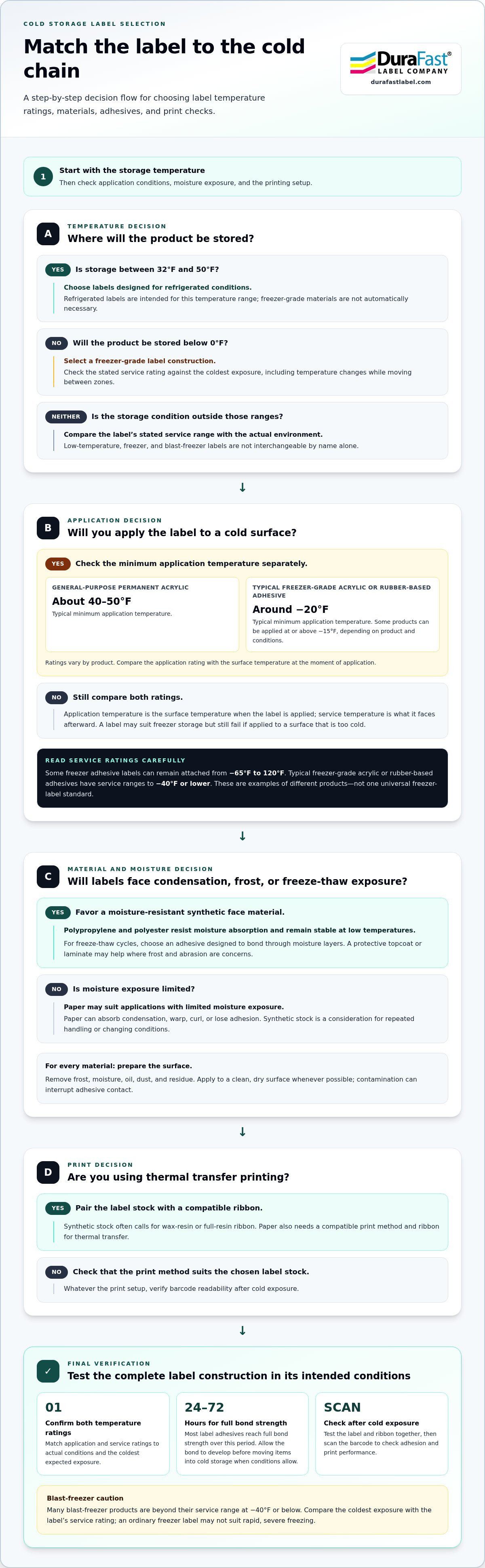
There isn’t one universal range for every freezer label. Some freezer adhesive labels can remain attached from -65°F to 120°F, while typical freezer-grade acrylic or rubber-based adhesives have a service range to -40°F or lower. Those figures describe different products, not a single standard. Check the label’s stated range against the actual environment.
Face material matters too. A synthetic film and its adhesive work together, but the material’s temperature tolerance doesn’t establish the adhesive’s application limit. A label applied warm and then moved into a freezer faces different conditions from one applied directly to a cold carton. For example, a freezer storage room maintained at 10°F with the least possible fluctuation is a condition freezer labels must withstand, according to the U.S. Government Publishing Office.
Low-temperature labels and freezer labels aren’t interchangeable by name alone. Refrigerated storage, frozen products, and blast-freezer exposure create different demands. Many blast freezer products are beyond their service range at -40°F or below. Match the stated service range to the coldest expected exposure, including temperature fluctuations during movement between zones.
Adhesive Application and Service Temperatures
Application temperature is the surface temperature when the label is applied; service temperature describes the conditions it faces afterward. Both matter: an adhesive may hold in a freezer but fail if applied to a surface that is too cold.
General-purpose permanent acrylic adhesive typically has a minimum application temperature of about 40-50°F. By contrast, a typical freezer-grade acrylic or rubber-based adhesive has a minimum application temperature around −20°F, with service temperatures to −40°F or lower. Some freezer adhesive labels can be applied at or above -15°F, depending on the product and application conditions. These specifications vary, so compare the application and service ratings separately.
Prepare the surface before applying a label. Remove frost, moisture, oil, dust, and residue, since contamination can interrupt adhesive contact. When conditions allow, apply the label at room temperature and let it bond before moving the item into cold storage. Most label adhesives reach full bond strength over 24-72 hours, so early handling can affect performance.
Thermal transfer labels also require a compatible ribbon. Test the label and ribbon together in the intended conditions, then scan the barcode after cold exposure. This checks adhesion and print performance before labels are used for daily inventory work.
How much do freezer labels cost per roll or per label? Price depends on roll size, material, adhesive construction, and order quantity. Compare these details with the temperature ratings to find a label that suits warehouse needs.
What are freezer-grade labels?
Freezer-grade labels combine a face material and adhesive designed for frozen storage. Choosing the best labels for a cold storage warehouse means matching both components to the surface, moisture exposure, temperature changes, and printing requirements.
Polypropylene and polyester label materials resist moisture absorption and remain stable at low temperatures. A freezer-suitable adhesive must also bond under application conditions and stay attached during storage and handling.
There is no single best brand or product for every warehouse. To choose the best labels for a cold storage warehouse, compare face material, adhesive, temperature ratings, and printing method with actual operating conditions, including condensation and freeze-thaw exposure.
Moisture Barriers and Freeze-Thaw Cycles
A moisture-resistant face helps protect the label from condensation that could weaken the material or bond. This is important when products move between cold storage and warmer areas, where moisture may form on the label.
During freeze-thaw cycles, moisture can form a slick layer between a label and the item. An adhesive designed to penetrate moisture layers may bond to the underlying surface. Apply labels to clean, dry surfaces whenever possible, since frost, oil, dust, and residue can interfere with adhesion.
Paper and Synthetic Freezer Labels
Paper labels can absorb condensation, then warp, curl, or lose adhesion. Polypropylene and polyester resist moisture absorption. Choose synthetic stock for repeated handling or changing conditions, and consider a protective topcoat or laminate where frost and abrasion are concerns.
Paper may suit applications with limited moisture exposure, but it needs a compatible print method and, for thermal transfer, ribbon. Synthetic stock often calls for wax-resin or full-resin ribbon; test the label and ribbon together. These choices help determine which labels best meet a cold storage warehouse’s inventory needs.
Blast-freezer labeling needs particular care. Many blast freezer products are beyond their service range at -40°F or below, so a label suited to an ordinary freezer may not suit rapid, severe freezing. Compare the coldest exposure with the label’s service rating, not just its application rating.
A product name alone does not establish that a Freez-R-Mark freezer label suits every warehouse condition. Check the stated face material, adhesive application and service temperatures, and moisture performance. A pallet-rack label may face different abrasion and condensation than one applied directly to a carton.
Keep the print legible as well as the bond secure. A label that stays attached but smudges can still disrupt scanning and inventory handling. Check the barcode after exposure to the warehouse’s real cold and moisture conditions, and assess whether the label remains flat, readable, and firmly attached.
How do I prevent labels from failing in cold storage?
Choose label material, adhesive, size, and print method for the conditions each label will face. Every component affects whether it stays attached, readable, and scannable.
Polypropylene, Polyester, and Vinyl
Polypropylene, polyester, and vinyl are synthetic label materials that resist moisture better than paper. That matters when frozen products face condensation, abrasion, or repeated handling.
Polypropylene resists water and can remain legible when condensation forms. Polyester resists moisture and abrasion, making it useful for frequently handled items. Vinyl is durable and resists extreme temperatures. For rack labels exposed to repeated contact, polyester’s abrasion resistance may help; for temperature exposure, consider vinyl.
Material alone does not determine performance. Pair the face stock with an adhesive designed for the surface. Polyethylene and polypropylene can be difficult to bond to, so a pressure-sensitive label for plastic packaging may need a different adhesive from one for a smooth metal shelf.
Label Size, Material, and Print Method
Label size, material, and print method work together to support adhesion and legibility. Smaller labels and rounded corners are less prone to lifting in cold environments, particularly where edges can catch during handling.
Use a moisture-resistant synthetic face stock, such as BOPP or polyester, when condensation could weaken paper. Apply labels to clean, dry surfaces free of frost, grease, dust, and residue. For freeze-thaw exposure, choose an adhesive that can bond through moisture layers to the underlying material. Protective laminates or topcoats can help shield labels from frost, abrasion, and repeated handling.
Thermal transfer and direct thermal labels differ in printing method and use. Direct thermal labels need no ribbon and can suit short-term applications. Thermal transfer labels use a ribbon and are often better suited to demanding environments, synthetic materials, and longer-lasting print.
Synthetic freezer labels often need wax-resin or full-resin ribbon. Test the ribbon and label together, then check that the barcode remains legible after cold exposure. A combination that prints clearly at room temperature may behave differently after storage or handling.
Before adopting a label across a warehouse, test it on the actual package, bin, or rack surface. Include normal handling, condensation exposure, and scanning distance. A label that stays attached but produces a smeared or unreadable barcode can still interrupt inventory work.
Finally, consider how long the label must last. Short-term carton identification may suit direct thermal printing, while durable synthetic labels with thermal transfer printing suit applications that require longer-lasting print. Match the label construction to the frozen environment and the information workers need to scan.
Cold-chain inventory tracking and barcode scanning
Cold-chain tracking depends on labels that stay attached and barcodes that remain readable at low temperatures. Frost, placement, and barcode layout all affect scanning reliability across warehouse operations.
Frost and Barcode Scan Reliability
Frost can cover barcode bars or create glare, making the pattern harder for a scanner to read. A label may stay attached but fail its inventory purpose if frost obscures the code.
Check scan performance under the warehouse’s actual conditions. Clear frost from the barcode area before scanning, and inspect print contrast and damage during routine handling. If a scan fails, check the label surface, frost coverage, and print condition before changing the code or scanning process.
Rack and Shelf Barcode Labels
Rack and shelf barcode labels identify fixed warehouse locations, helping workers associate inventory with the correct storage position. Multi-level designs can show distinct location codes for separate beam levels, supporting accurate put-away and retrieval.
Formats such as 3" x 8" labels can provide room for multiple levels of location information. Choose a layout that keeps each barcode distinct and visible from the scanning position. Apply labels to smooth, clean surfaces such as pallet racking, shelves, storage bins, carts, or doors. Frost can also reduce the holding strength of magnetic rack labels when it builds between the magnet and beam.
Label Standards and Maintenance Practices
Use the barcode symbology supported by your inventory system and scanning workflow. Linear and 2D codes can both carry location or item information; custom layouts should keep identifiers clear and consistently positioned.
No single barcode format suits every warehouse task. Define the information each code must represent, then keep the format consistent across inventory records and physical labels. Place labels where scanners can reach them without obstruction, and avoid seams or curved edges.
Inspect labels during routine inventory checks. Clear frost from barcode areas, look for peeling edges or abrasion, and scan a sample after cold exposure. Replace labels when damage obscures the code or location identifier. These checks can catch failures before they disrupt picking, put-away, or transfers.
Polypropylene or polyester label stock can resist moisture absorption, while a compatible adhesive helps secure the label to its surface. Print performance matters too: thermal transfer labels paired with an appropriate ribbon can support durable barcode printing on synthetic materials. Test the complete label, ribbon, and scanner combination under real handling conditions. For help matching label and barcode equipment to your workflow, discuss your labeling needs.
Cold Temp Labels for refrigerated warehouses
Refrigerated warehouses need labels suited to chilled conditions, not automatically the extreme temperatures of a freezer. Refrigerated labels are intended for 32°F to 50°F (0°C to 10°C), while labels for frozen storage must meet different adhesive and material demands.
For this temperature range, choose pressure-sensitive labels made with synthetic films, freezer-grade adhesives, and protective laminates for permanent or high-traffic use. Each component has a role: the face stock resists moisture, the adhesive secures the label, and the laminate helps protect printed information during handling.
What types of labels work best in cold storage warehouses? For refrigerated rooms, use synthetic, adhesive-backed labels designed for chilled conditions and the application surface. For colder frozen zones, choose a freezer-grade construction suited to those temperatures.
Surface preparation matters in refrigerated rooms, too. Apply labels to clean, dry surfaces because moisture, dust, or grease can interfere with adhesion. A label on a damp carton or greasy rack may lift even when its material suits the room’s temperature range. Check surface conditions during application, especially where condensation forms.
Separate location identification from handling instructions. A durable barcode label can identify a shelf or product, while a bright-colored sticker can flag refrigeration or freezing requirements and handling hazards. The National Institute of Standards and Technology notes the use of bright-colored stickers to identify these requirements and hazards. Keep color cues consistent with the warehouse’s established process.
Thermal printing can produce warehouse labels, but the print method alone does not make a label suitable for cold conditions. Match the stock and adhesive to the environment, then check that text and barcodes remain readable after routine handling. A permanent label for a frequently used shelf may need more abrasion resistance than a short-term carton label.
Plan for the coldest and wettest points in the refrigerated operation, including doorways where conditions can change. Inspect labels where condensation repeatedly forms, and replace damaged or unreadable identifiers before they interrupt scanning. This helps prevent choosing freezer materials when chilled-room labels are a better fit, or using ordinary labels where moisture and handling require greater durability.
For help aligning label materials and printing choices with your refrigerated warehouse, discuss your cold-storage labeling needs.
DuraFast Label Company: Epson ColorWorks C6000A
DuraFast Label Company offers label printers and supplies to support warehouse labeling workflows. The Epson ColorWorks C6000A is a reliable option for color label production, while the Zebra ZT411 Thermal Transfer Printer supports thermal transfer workflows.
For cold storage, match label stock and adhesive to application and storage conditions, then test barcode adhesion and scan readability. DuraFast offers DuraFast Matte Chemical Labels; choose labels according to the specific environment and use.
Explore the available options at DuraFast Label Company, or contact the team to discuss your warehouse labeling needs.
Build a Labeling Setup That Fits Your Workflow
Turn warehouse conditions into clear selection criteria. Consider where each label will be applied, what information it must carry, and how workers will scan it during normal operations. This practical approach helps narrow the best labels for a cold storage warehouse without relying on temperature alone.
Before standardizing a label, test the complete setup on representative packaging, shelves, or racks. Check whether it stays in place, printed information remains readable, and scanners capture the barcode where staff use it. These checks can reveal workflow problems before a change is rolled out across the operation.
DuraFast Label Company offers label printers and supplies for warehouse identification workflows. If you’re ready to explore options for your labeling setup, contact DuraFast Label Company. A well-matched setup can make everyday identification easier for your team.
Frequently Asked Questions
What adhesive works in a freezer?
Use a freezer-grade pressure-sensitive adhesive formulated to remain tacky at low temperatures. Acrylic and rubber-based adhesives are common freezer-grade types, but their application and service ratings can differ. A label might tolerate frozen storage yet require a warmer surface for application. Match the adhesive rating to the package material and application conditions, then test it on the actual container before using it across inventory.
What adhesives bond reliably to cold, damp, or frosty surfaces?
For a cold surface with light moisture, choose an adhesive designed to penetrate moisture layers and bond to the material underneath. Heavy frost, grease, and dirt can still interfere with contact, so remove them before application whenever possible. A damp plastic tote and a frosted cardboard case pose different bonding challenges. Test the label on the same surface type and condition found in the warehouse instead of relying on the adhesive description alone.
What temperature ranges can warehouse labels withstand?
Warehouse label ranges depend on both the adhesive and face material. Typical freezer-grade acrylic or rubber-based adhesives may apply around -20°F and serve to -40°F or lower, while some freezer labels can remain attached across -65°F to 120°F. These are distinct product examples, not a universal rating. Compare the coldest application condition with the service range, and include temperature changes during transport between refrigerated and frozen areas.
Which label printing technologies are best for cold storage labels?
Thermal transfer is often a strong option for synthetic labels and longer-lasting print in demanding environments. Choose a compatible wax-resin or resin ribbon for synthetic freezer stock, and test the combination. Direct thermal printing needs no ribbon and can suit short-term identification, such as carton labels moving quickly through distribution. Choose based on print life, face material, moisture exposure, and barcode readability after handling.
How should labels be applied in refrigerated and freezer conditions?
Apply labels to a clean, dry surface and remove frost, oil, dust, or residue first. If possible, label products at room temperature, then allow the adhesive time to bond before chilling. Most adhesives reach full bond strength over 24-72 hours, so avoid rough handling immediately after application. If labeling must happen in the cold, use stock rated for that application temperature and press the label firmly across its full surface.
How can cold storage labels be tested for durability and scanability?
Test a sample on the actual packaging, rack, or bin under normal application and handling conditions. Expose it to cold storage and expected condensation or freeze-thaw movement. Then check for lifted edges, curling, smudged print, or surface damage. Scan the barcode with the equipment workers use and from their normal approach angle. Record which label and ribbon combination stays attached and readable throughout the workflow.
How much do freezer labels cost per roll or per label?
Prices depend on roll size, material, adhesive, and order quantity.