GHS BS5609 Chemical Label Printing Solutions: The 2026 Compliance Guide
5th Sep 2026
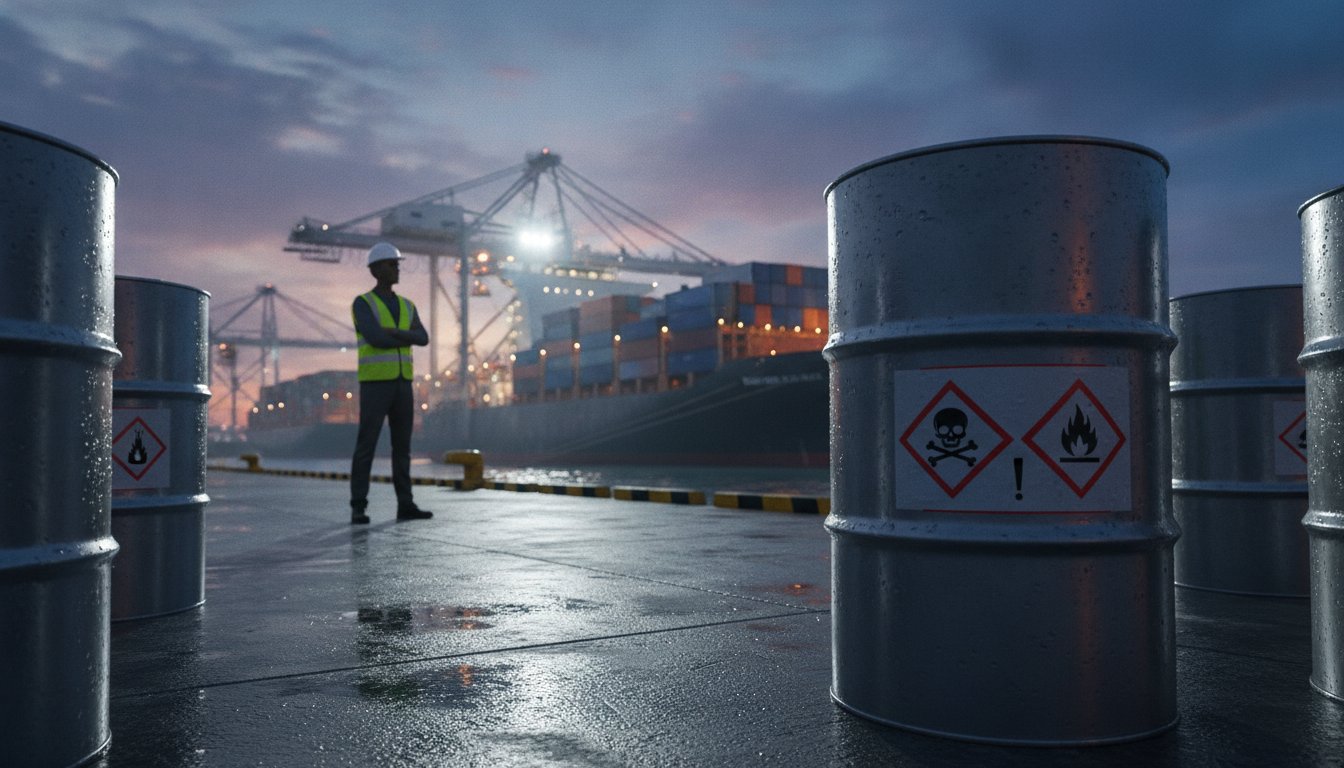
By November 20, 2026, every employer in North America must have their workplace labeling and Hazard Communication programs fully updated to GHS Revision 7 standards. It's a massive shift that leaves many safety managers worried about labels peeling in harsh conditions or the high costs of pre-printed stock. You likely already know that a simple sticker isn't enough when your products face the open sea. You need GHS BS5609 chemical label printing solutions that are as tough as the chemicals they identify.
We understand the pressure of meeting strict OSHA and WHMIS requirements while trying to reduce label waste and inventory overhead. This guide will help you master the technical side of BS5609 so you can implement a durable, cost-effective in-house system. We'll walk through the 2026 compliance deadlines, explain why DuraFast Matte Chemical Labels are critical for seawater durability, and show you how tools like the Epson ColorWorks C6000A and BarTender software make 100% compliance a reality for your facility. By the end of this guide, you'll have a clear roadmap to labels that survive three months of seawater immersion without breaking your budget.
Key Takeaways
- Learn the critical 2026 OSHA deadlines for GHS Revision 7 and how to ensure your labels meet international marine durability standards.
- Understand the difference between Section 2 and Section 3 BS5609 certifications to guarantee your labels stay compliant during sea transit.
- Compare one-step inkjet printing with traditional thermal methods to identify the best GHS BS5609 chemical label printing solutions for your specific volume.
- Discover how to build a seamless in-house workflow using the Epson ColorWorks C6000A and BarTender software to eliminate label waste.
- Explore the benefits of using DuraFast Matte Chemical Labels to ensure your hazard warnings remain legible after three months of seawater immersion.
Understanding GHS and BS5609 Standards for Chemical Labeling
GHS stands for the Globally Harmonized System of Classification and Labelling of Chemicals (GHS). It's a worldwide standard that ensures chemical hazards are communicated the same way, regardless of where they're produced. In North America, OSHA in the United States and WHMIS in Canada have aligned their standards with this system. This alignment creates a safer, more predictable market for chemical trade across borders. It ensures that a worker in one facility sees the same hazard warnings as a technician in another, regardless of which state or province they are in.
One of the most critical parts of GHS is the "Red Diamond" pictogram. These symbols must feature a distinct red border to be compliant. Because of this requirement, GHS BS5609 chemical label printing solutions must support reliable color output. You can't rely on simple black and white printers if you want to meet these international safety standards. The red border is not a suggestion; it's a mandatory element of the hazard communication framework.
The 2026 Regulatory Landscape for Chemicals
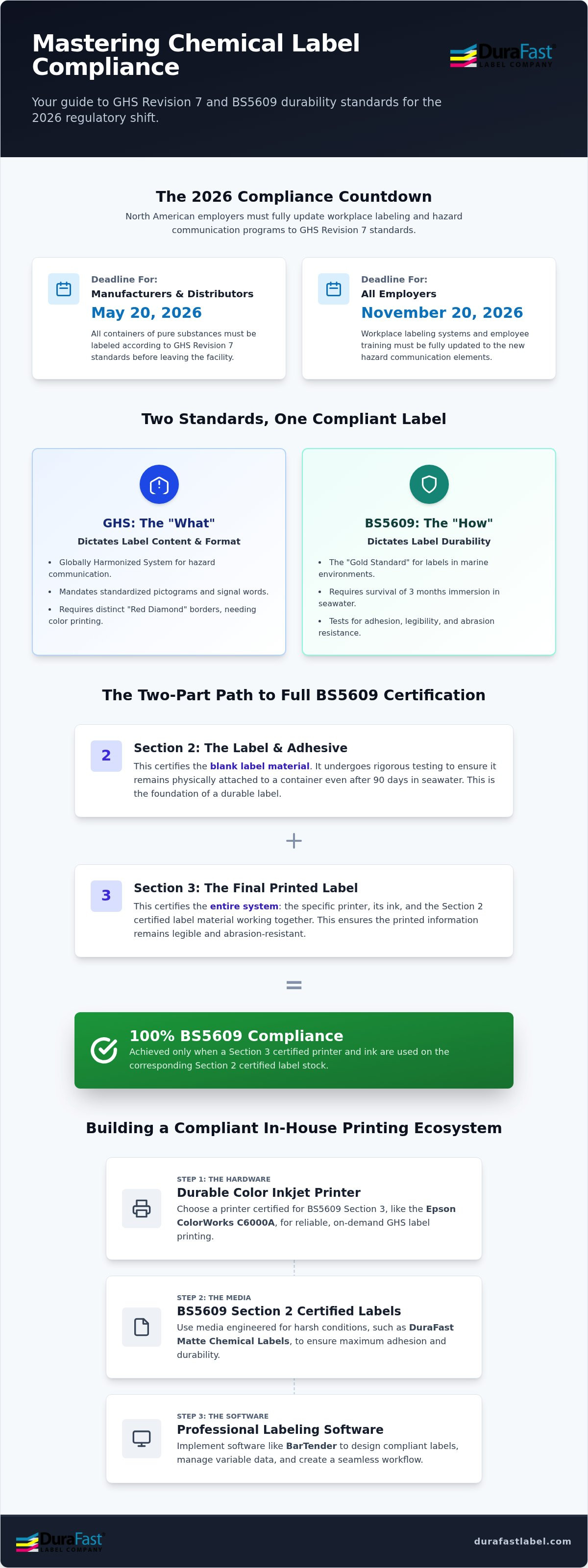
The U.S. Occupational Safety and Health Administration (OSHA) has updated its Hazard Communication Standard to align with GHS Revision 7. This update brings several critical deadlines that businesses must track closely. By May 20, 2026, manufacturers and distributors must ensure all containers of pure substances leaving their facilities are labeled according to these new Revision 7 standards. Employers then have until November 20, 2026, to update their workplace labeling and train employees on the new elements. GHS compliance is a combination of standardized pictograms and signal words. Switching to on-demand color label printers helps you avoid the risk of using outdated hazard information. You only print the exact labels you need, ensuring every container stays current with the latest safety data.
Why BS5609 is the "Gold Standard" for Durability
While GHS dictates the content of your label, BS5609 dictates how well that label survives. This British Standard is specifically designed for pressure sensitive adhesive labels used in marine environments. It's the benchmark for international shipping because it requires labels to survive three months of seawater immersion. If your labels peel or fade during a voyage, you face massive liability and rejected shipments at international ports. Compliance relies on three core criteria: superior adhesion to the container, permanent legibility of the text, and high abrasion resistance. Using GHS BS5609 chemical label printing solutions ensures your products remain identifiable even in the harshest conditions. This certification protects your business from the logistical nightmares that come with unreadable or missing hazard warnings.
The Critical Role of BS5609 Section 2 and Section 3 Certification
Many safety managers assume that buying a roll of "certified" labels is the final step in compliance. It's a dangerous mistake. BS5609 isn't a single certificate; it's a two-part standard. Section 2 covers the raw label material and its adhesive. Section 3 covers the final printed product. You haven't achieved 100% compliance until your specific printer, ink, and media are certified as a single unit. This synergy is the foundation of effective GHS BS5609 chemical label printing solutions.
To meet the OSHA Hazard Communication Standard, your labels must survive the journey from the factory to the end user. If a drum falls overboard or sits on a rain-soaked dock, the hazard information must remain attached and legible. This is why the distinction between the substrate and the print is so vital. A perfect adhesive is useless if the ink washes away in the first storm.
Evaluating Media: Section 2 Requirements
Section 2 testing focuses on the physical durability of the blank substrate. It ensures the label won't peel off a drum during a 90-day soak in seawater. Testers look for dimensional stability, checking if the material shrinks or warps when exposed to extreme temperature fluctuations. If the adhesive fails, the hazard information is lost. We offer a wide range of labels for inkjet that have already passed these rigorous adhesive bond tests. These substrates provide the reliable base needed for high-exposure environments.
The Printer Factor: Section 3 Compliance
Section 3 is the most common point of failure for in-house systems. This part of the standard tests the legibility and abrasion resistance of the actual printed image. You can't use standard dye-based inks. Pigment-based inks are mandatory because they provide the necessary chemical resistance to withstand harsh industrial environments. The Epson ColorWorks C6000A is a premier choice for this task. When paired with DuraFast Matte Chemical Labels, the resulting print survives 90 days of seawater immersion and intense artificial weathering. This combination ensures your hazard pictograms remain vivid and readable even after months of UV exposure and salt spray.
Verification is key. You must confirm that your specific printer model and ink cartridges are listed on the media manufacturer's Section 3 certificate. A label material might be Section 2 compliant on its own, but it only gains Section 3 status when the ink-media bond is proven. DuraFast simplifies this by providing pre-vetted GHS BS5609 chemical label printing solutions that take the guesswork out of the certification process. If you aren't sure if your current printer-ink-media trio is fully certified, request a compliance audit from our team to ensure your shipments aren't at risk.
One-Step Color Inkjet vs. Two-Step Thermal Labeling
Historically, chemical companies relied on a two-step process to meet safety requirements. They would stock thousands of pre-printed labels that already featured the red GHS diamonds. Then, they used a thermal transfer printer to add black text and specific hazard data. While this was once the industry standard, it created massive inventory headaches. One-step GHS BS5609 chemical label printing solutions have changed the game by allowing you to print the entire label, including the color pictograms and variable data, on a single blank roll of white substrate.
This shift to one-step printing isn't just about convenience. It's about eliminating the errors that happen when a printer fails to align black text perfectly inside a pre-printed red diamond. When you print everything in a single pass, every pictogram is crisp, centered, and fully compliant with international standards.
Efficiency and Cost Analysis
The hidden cost of the two-step method is obsolescence. With the 2026 GHS updates, any pre-printed labels that don't match new classification standards are effectively waste. By switching to a one-step inkjet system, you reduce your SKU count to just a few sizes of blank media. This agility is vital for new chemical product launches. You can design a label in the morning and have compliant containers ready for shipment by the afternoon. For a deeper look at how this technology works, check out our Epson ColorWorks Guide. This approach ensures you aren't sitting on thousands of dollars of unusable pre-printed stock when regulations change.
Durability Comparison: Inkjet vs. Thermal Transfer
Durability is where the choice becomes highly technical. Thermal transfer systems use resin ribbons to melt an image onto a label's surface. It's a proven method for many warehouse tasks. However, pigment inkjet technology offers a different level of protection for GHS applications. Pigment ink chemically bonds with matte media for superior abrasion resistance. This bond is what allows a label to survive the scraping and scuffing of a long sea voyage without the hazard symbols fading or smearing.
While we often recommend industrial thermal transfer labels for standard tracking or secondary non-GHS applications, they often struggle to meet the full BS5609 Section 3 requirements when color is involved. Color thermal ribbons are expensive and difficult to manage compared to pigment ink cartridges. Pigment inkjet printers like the Epson C6000A eliminate these mechanical hurdles, providing a more reliable path to 100% compliance for small and mid-sized firms.
Implementing Your In-House GHS Printing Workflow
Setting up an in-house system isn't just about unboxing a printer. It's about creating a repeatable, auditable process that guarantees safety and regulatory adherence. To implement successful GHS BS5609 chemical label printing solutions, you must follow a structured workflow. This starts with selecting hardware that can handle industrial environments and matching it with media that's been specifically tested for your printer model.
Choosing the Right Hardware
The Epson ColorWorks C6000A is built specifically for these industrial GHS workflows. It offers a 1200 dpi resolution. This high resolution is vital because safety warnings often use small fonts to fit multiple languages or complex hazard statements on a single container. If the text is fuzzy or the pictograms are blurred, you aren't compliant. You can shop Epson inks to ensure you always have the pigment-based supplies needed to create a permanent, chemical-resistant bond on every label you produce.
Once you have the printer, you must source media that is specifically certified for that model. Using generic "waterproof" labels is a common mistake that leads to Section 3 failures. Your media provider should give you documentation proving the ink and material combo survived the mandatory 90-day seawater immersion test. Without this model-specific certification, your labels won't meet the durability standards required for international maritime shipping.
Software and Template Management
Software is the bridge between your chemical data and the physical label. BarTender Professional allows you to build templates that pull data directly from your ERP or chemical database. This automation is a lifesaver. It ensures that when a chemical property changes in your database, the label updates automatically. You don't have to worry about manual entry errors that could lead to dangerous mislabeling or costly fines.
Your templates must manage signal words, hazard statements, and pictogram sizes. GHS regulations specify how large a pictogram must be relative to the container dimensions. BarTender can automate the "Red Diamond" selection based on the specific hazard class of the chemical. This ensures your labels are always accurate for both OSHA and WHMIS standards without requiring a design expert on the warehouse floor.
The final step in your workflow is regular validation. You should periodically test label adhesion on your actual containers, especially if you change container materials. Check for legibility after labels are exposed to the specific chemicals you package. If you're ready to modernize your facility and eliminate the stress of regulatory audits, contact our compliance experts to design your custom printing workflow today.
DuraFast Solutions: The Complete GHS BS5609 Ecosystem
Achieving 100% compliance shouldn't be a guessing game for your safety team. DuraFast Label Company simplifies the entire process by providing a curated selection of GHS BS5609 chemical label printing solutions. We don't just ship boxes; we provide a complete ecosystem that integrates high-performance hardware, specialized software, and certified media. This approach ensures that every component in your labeling workflow is designed to work together, saving you from the frustration and liability of mismatched supplies.
Many businesses struggle because they buy a printer from one vendor and media from another. When those labels fail a durability test or the ink smears, finding a solution becomes a logistical nightmare. By choosing a partner that specializes in the full bundle, you get guaranteed compatibility. We offer expert consultation to help you choose between Epson color label printers and Afinia solutions based on your specific production volume and chemical environment. This ensures you invest in the right technology for your long-term ROI.
DuraFast Matte Chemical Labels
Our proprietary DuraFast Matte Chemical Labels are the heart of our compliance promise. We've engineered these labels specifically for the Epson C6000 series to ensure guaranteed Section 3 compliance. They don't just stick; they survive. These labels offer incredible resistance to solvents, oils, and harsh industrial cleaners that would destroy standard inkjet media. For a deeper dive into the technical requirements for your facility, read our guide on GHS Label Printer Essentials. This media ensures your hazard warnings remain legible even after heavy exposure to the chemicals they are meant to identify.
Beyond the Printer: Total System Support
Real value in a labeling system comes from reliability and zero-waste production. Sourcing your media and ink from a single specialized provider reduces downtime and simplifies your inventory management. We provide high-capacity ink cartridges and reliable media rolls that keep your production lines moving without constant maintenance. We've already done the heavy lifting of vetting these products, so you can focus on your core business operations instead of worrying about regulatory audits.
Our support extends to software integration as well. We help you bridge the gap between your chemical database and your physical labels using BarTender Professional. This total system support transforms a complex regulatory requirement into a simple, automated task. If you're ready to secure your 2026 compliance and streamline your in-house production, Contact DuraFast for a GHS Compliance Consultation today. We'll help you build a durable, cost-effective system that protects both your workers and your bottom line.
Secure Your Chemical Compliance Strategy for 2026
The 2026 deadlines for GHS Revision 7 are approaching quickly. By November, every workplace program must be updated to reflect these new safety standards. You've learned that true compliance isn't just about the right printer; it's about the synergy between hardware, pigment inks, and certified media. Transitioning to in-house GHS BS5609 chemical label printing solutions allows you to eliminate pre-printed inventory waste while ensuring your labels survive the harshest marine environments.
DuraFast Label Company is the North American leader in in-house labeling hardware. We provide the specialized BS5609 Section 3 certified media and expert technical support you need to build a seamless GHS workflow. Don't let complex regulations or peeling labels disrupt your operations. Our team has already done the heavy lifting of vetting the best products for your facility.
Browse GHS BS5609 Printing Solutions at DuraFast Label Company and take the first step toward a cost-effective, compliant future. You've got the tools and the knowledge; now it's time to implement a system that protects your business and your workers.
Frequently Asked Questions
What is the difference between BS5609 Section 2 and Section 3?
Section 2 certification focuses on the blank label material and its adhesive bond. It ensures the label won't peel off a drum during seawater immersion. Section 3 certification covers the final printed product. It tests the specific combination of a printer, its ink, and the label material together. You only have 100% compliance when your specific ink and printer model are certified for use with your chosen BS5609 media.
Can I use any inkjet printer for GHS compliant labels?
No, you cannot use a standard home or office inkjet printer for GHS labels. Most consumer printers use dye-based inks that smear or wash away when exposed to moisture and chemicals. To achieve GHS BS5609 chemical label printing solutions, you must use an industrial pigment-based inkjet printer. These machines are engineered to create a permanent bond with specialized matte media that resists solvents, oils, and extreme environmental conditions.
Why is pigment ink required for chemical label printing?
Pigment ink is required because it uses solid particles that sit on the label surface and chemically bond with the coating. Unlike dye-based inks, pigment inks don't dissolve in water or oils. This provides the high level of smudge resistance and UV stability needed for chemical containers. It's the only ink technology capable of passing the rigorous 90-day seawater immersion and artificial weathering tests required by the BS5609 durability standard.
Do GHS labels need to be color or can they be black and white?
GHS labels must include color. The regulation specifically requires hazard pictograms to have a red diamond border. While the rest of the text and variable data can be black, the red border is mandatory for compliance. Using a color inkjet printer allows you to print these red diamonds and all other hazard information in a single pass on blank white labels. This is much more efficient than managing an inventory of different pre-printed stocks.
How long do BS5609 certified labels last in seawater?
BS5609 certified labels are tested to withstand a minimum of three months, or 90 days, of continuous immersion in seawater. This test ensures that the label remains attached and the printed information stays perfectly legible even if a container is lost at sea. This durability is essential for international maritime shipping. It protects your business from liability and ensures that hazardous materials remain identifiable in emergency recovery or salvage scenarios.
Is the Epson ColorWorks C6000A BS5609 certified?
Yes, the Epson ColorWorks C6000A is a leading choice for GHS BS5609 chemical label printing solutions. However, the certification applies to the full system rather than just the hardware. When you use the C6000A with its original pigment inks and DuraFast Matte Chemical Labels, the resulting output is fully Section 3 certified. This combination is specifically engineered to meet the highest standards for adhesive strength and print legibility in the harshest industrial and marine environments.
What software is best for designing GHS chemical labels?
BarTender Professional is widely considered the best software for managing GHS chemical labels. It features specialized templates that automate the inclusion of signal words, hazard statements, and the correct pictograms based on your chemical database. This integration reduces the risk of manual entry errors and ensures every label meets OSHA and WHMIS size requirements. It's an essential tool for businesses looking to streamline their in-house printing workflow and maintain perfect regulatory accuracy at all times.
Does DuraFast offer BS5609 compliant labels for Afinia printers?
Yes, DuraFast Label Company offers a full range of BS5609 compliant labels specifically designed for Afinia printers, including the L502 and L801 models. We've vetted these materials to ensure they provide the necessary chemical resistance and adhesive bond when paired with Afinia's pigment ink systems. Sourcing your media and hardware from a single specialized provider like DuraFast ensures you have the documentation needed to prove compliance and long-term durability during a safety or regulatory audit.