Calculating the Cost of Printing Labels In-House: A 2026 Financial Guide
28th Jun 2026
What if your "convenient" outsourcing partner is actually charging you a massive markup just to cover their own shipping and setup overhead? You've likely felt the sting of paying for setup fees on a minor design change or watching inventory go to waste when a product spec shifts. Calculating the cost of printing labels in house is the first step toward stopping these losses. It's frustrating to pay premium prices for heavy rolls and wait days for delivery. We know that taking production into your own hands feels like a big step, but it's often the smartest way to reclaim your margins.
This guide helps you master the math behind in-house production so you can see exactly how much your business can save by switching from outsourcing. We'll move past the guesswork to provide a clear per-label cost comparison and help you identify the break-even point for hardware investments. You'll gain a practical framework to justify the move to stakeholders and streamline your 2026 operations. Let's look at the real numbers and find your path to more efficient, reliable production.
Key Takeaways
- Learn how to calculate the total system cost by factoring in hardware, software, and recurring media expenses for a full financial picture.
- Identify your specific break-even point where the cost of printing labels in house becomes more profitable than outsourcing to a print shop.
- Discover how to eliminate wasted inventory and expensive setup fees by adopting an on-demand production model.
- Master practical strategies to lower your per-label expenses through layout optimization and choosing the right inkjet labels for your needs.
- Compare hardware options ranging from entry-level startups to industrial-grade powerhouses like the Epson ColorWorks C6000A to find your perfect fit.
The True Cost of Printing Labels In-House: An Overview
Think of in-house label production as a complete ecosystem rather than just a hardware purchase. It's a strategic system that combines specialized hardware, high-quality media, and intuitive design software. When you evaluate the cost of printing labels in house, you're looking at a shift from a "pay-per-unit" model to an "on-demand" production model. This transition gives you total control over your brand's physical presentation.
The "On-Demand" advantage is the primary driver for most growing businesses. Instead of ordering 10,000 labels to get a volume discount, you print exactly what you need for today's production run. This eliminates the risk of obsolescence; if a logo changes or a regulation shifts, you don't have to throw away thousands of dollars in pre-printed stock. By 2026, advancements in label printing technologies have made high-speed, professional results accessible to even small-scale operations.
Direct vs. Indirect Costs
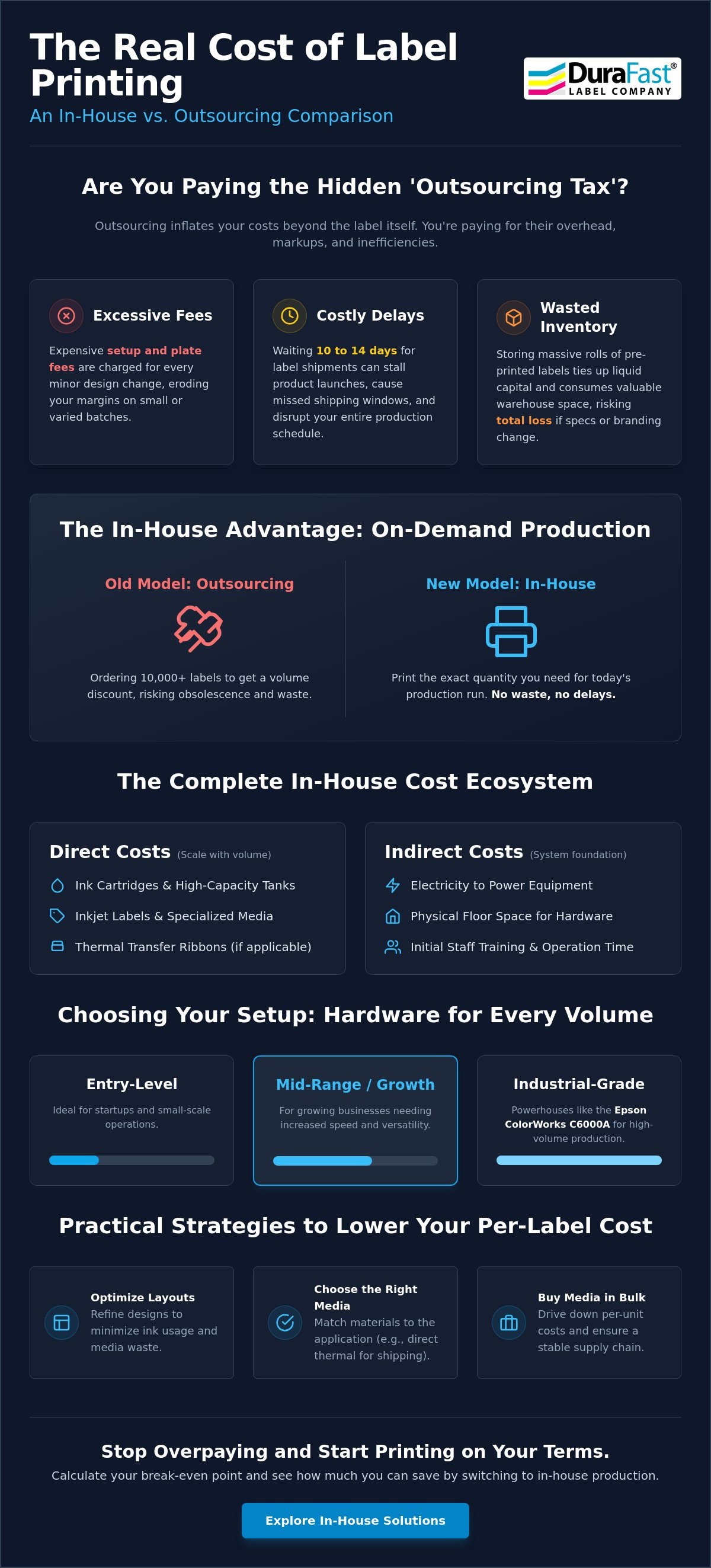
Understanding your financial commitment requires looking at two different categories of spending. Direct costs are the visible expenses that scale with your volume. Indirect costs are the "hidden" requirements for keeping the system running. Total Cost of Ownership represents the complete financial commitment of your printing system over its entire operational life, including both the purchase price and every ongoing expense.
- Direct Costs: These include ink cartridges, inkjet labels, and thermal ribbons.
- Indirect Costs: You'll need to account for electricity, the physical floor space for the equipment, and the time spent on initial staff training.
The 'Outsourcing Tax': What You Pay Extra
Outsourcing often carries a hidden tax that inflates the cost of printing labels in house by comparison. When you work with a third-party print shop, you aren't just paying for the label itself. You're paying for their business overhead and profit margins. Common "outsourcing taxes" include:
- Setup and Plate Fees: Traditional flexographic printing often requires expensive plates for every design change.
- Lead-Time Delays: Waiting 10 to 14 days for a shipment can stall your product launches or cause missed shipping windows.
- Inventory Carrying Costs: Storing massive rolls of labels takes up warehouse space and ties up your liquid capital.
Some critics argue that ink is too expensive for DIY setups. However, 2026 industrial models feature high-capacity ink tanks that significantly lower the price per millilitre. This modern technology ensures that your per-label cost remains competitive even on high-coverage designs.
The 4 Main Pillars of Your In-House Cost Template
Building a reliable financial model requires looking at four specific categories. These pillars form the foundation of your budget and determine the overall cost of printing labels in house. If you miss even one category, your ROI calculations will be off. You need to view these as interconnected parts of a single production engine.
First, consider your hardware investment. You shouldn't look at the sticker price as a one-time hit to your bank account. Instead, amortize that cost over the printer's expected lifespan, which is usually three to five years. This gives you a monthly "equipment fee" to work into your per-label math. It's a much more accurate way to see how the machine pays for itself over time.
Next, account for consumables and media. This includes ink, inkjet labels, and thermal ribbons. Choosing the right substrate is vital. A matte label might be perfect for a standard shipping box, while a chemical-resistant label is necessary for industrial products or outdoor use. Each material has a different price point that affects your final margin.
Calculating Consumables: Ink and Media
Estimating ink costs is simpler than most people think. It's based on the percentage of coverage on your design. A simple text label uses very little ink. A full-bleed color photo uses much more. You can also save significantly by comparing direct thermal labels with thermal transfer options. Direct thermal doesn't require a ribbon, which makes it cheaper for short-term applications like shipping. Buying blank media in bulk is your best strategy for driving down per-unit costs and keeping your supply chain stable.
Software and Design Efficiency
Software is often the most overlooked pillar in a cost template. Using a professional tool like BarTender Professional reduces design errors that lead to wasted media and ink. You can choose between a one-time perpetual license or a monthly subscription, depending on your current cash flow. Labor costs have also dropped significantly because modern printers are designed for "load and go" operation. This means your staff spends less time babysitting the machine and more time on high-value tasks. If you're unsure which media fits your specific environment, reach out to our team for a personalized recommendation.
In-House vs. Outsourcing: The ROI Comparison
When you compare a typical 5,000-label run from a professional print shop against in-house production, the initial price per label often looks similar on paper. However, the print shop's quote usually hides the "outsourcing tax" we discussed earlier. To get their best rate, you're forced into high minimum order quantities (MOQs). If you only need 2,000 labels but have to buy 5,000 to get a discount, you're immediately overpaying for 3,000 units you might never use. The cost of printing labels in house removes this artificial barrier. You print exactly what you need for each batch, which keeps your upfront cash outlay low and your inventory lean.
Identifying your break-even point is the key to justifying the investment to your stakeholders. For many businesses, a mid-range printer pays for itself within six to twelve months of consistent use. This calculation must include the cost of obsolete labels, which is a massive hidden expense that most competitors ignore. When product specs change or a new marketing campaign launches, pre-printed rolls often become expensive trash. In-house printing eliminates this waste entirely by allowing for real-time updates to your designs. You also gain a massive time advantage. Instead of waiting three to five days for a courier to deliver your rolls, you can have a new product labeled and ready for shipping in minutes. This agility can be the difference between winning a new contract or losing out to a faster competitor.
The Hidden ROI of On-Demand Printing
Reducing MOQs from 1,000 to just one label opens up entirely new revenue streams for your business. You can easily test private labeling for specific clients or run short-term seasonal promotions without a major financial commitment. This flexibility lets you say "yes" to smaller, high-margin custom orders that a print shop would make too expensive to pursue. For a deeper dive into these benefits, check out our guide on how to Stop Outsourcing Label Printing and find your true ROI.
Maintenance and Downtime Risks
Maintenance is a real factor, but it shouldn't be a deterrent in your financial plan. You'll need to budget for printhead replacements and routine cleaning kits to keep the system running smoothly over several years. While these are recurring costs, they are predictable and manageable. The cost of occasional downtime is significantly lower than the risk of a third-party supplier missing a critical deadline. Reliability is key here. Choosing established brands like Epson or Afinia reduces your long-term risk because their components are built for demanding industrial duty cycles. These machines are engineered workhorses that minimize the chance of unexpected production halts, ensuring your line keeps moving.
Cost-Saving Strategies for In-House Production
Once you've committed to the transition, you need to focus on efficiency. Smart management is the key to lowering the cost of printing labels in house even further. Small adjustments in your daily workflow can lead to massive annual savings. You shouldn't just print; you should optimize every square inch of your media to maximize your investment. Every bit of saved space directly improves your bottom line.
Start by looking at your label layouts. Many businesses waste money by using only a fraction of the roll width. If you're printing a two-inch label on a four-inch roll, you're paying for empty space. Designing labels side-by-side allows you to utilize the full width of the roll and cut your media costs significantly. Additionally, use 'Draft Mode' for internal tracking or warehouse labels. This setting consumes much less ink while still providing perfectly legible barcodes for your scanners.
Selecting the Right Technology for Your Budget
Your choice between inkjet and thermal technology will dictate your long-term cost of printing labels in house. For simple, high-speed shipping labels, desktop thermal printers offer an unbeatable ROI. They don't require ink or toner, which makes them incredibly cost-effective for monochrome tasks. However, if you need full-color branding with high durability, inkjet is the standard choice. For 24/7 production environments, industrial-grade units are the best option. While they have a higher entry price, their lower consumable costs and rugged components make them cheaper over the course of millions of labels.
Bulk Purchasing and Media Management
Media management is another critical area for savings. Negotiating bulk rates for blank rolls can drop your per-label price by double-digit percentages. You must store these rolls in a cool, dry place to prevent degradation or adhesive bleeding that can cause printer jams. Don't skimp on the quality of your thermal transfer ribbons either. Low-quality ribbons often have abrasive backings that wear down your printhead prematurely. A high-quality ribbon acts as a lubricant, extending the life of your most expensive replacement part. Using premium thermal ribbons protects your hardware and ensures consistent scan rates.
Choosing between pigment and dye-based inks is a durability decision. Dye inks provide vibrant colors for retail shelves, but pigment inks are necessary for labels exposed to moisture or chemicals. Matching the ink to the job prevents costly re-printing and customer complaints. If you want a detailed breakdown of which technology fits your current volume, contact our experts for a personalized cost analysis.
Choosing Your Setup: Hardware for Every Volume
Selecting the right machine is the final step in managing the cost of printing labels in house. You don't need a massive industrial press to start seeing savings. Startups and boutique brands often thrive with entry-level color printers that offer professional results without a high upfront investment. These compact units are perfect for small batches where design flexibility is your main priority. They allow you to test new branding or seasonal packaging without the fear of wasting a huge inventory of pre-printed rolls.
For businesses with growing production lines, mid-range power is essential. The Epson ColorWorks C6000A is a flexible industrial workhorse that bridges the gap between desktop convenience and high-capacity output. It's built for reliability and integrates easily into existing workflows. If your primary goal is rapid production, high-volume units like the Afinia L801 use Memjet technology to fly through jobs at speeds that rival professional print shops. This level of speed ensures your labeling never becomes a bottleneck in your shipping department.
Logistics and warehouse teams often have different needs. If you're focused on compliance and shipping, industrial barcode printers offer the best monochrome efficiency. These machines are engineered for 24/7 duty cycles; they provide the reliability required for high-stakes logistics where a single unreadable barcode can lead to expensive chargebacks.
Why Epson ColorWorks is a 2026 Standard
PrecisionCore technology has changed the game for ink efficiency. It delivers sharp text and vibrant images while using significantly less ink than older systems. This efficiency is a major factor in lowering the cost of printing labels in house for modern businesses. When you pair this hardware with DuraFast Matte Chemical Labels, you get a finished product that resists smudging and chemicals. You can find specifically engineered Epson CW-C6000 labels to ensure your prints stay professional from the warehouse to the customer's doorstep.
Final Recommendation and Next Steps
Your path to a positive ROI follows a simple progression. First, assess your weekly volume to determine your hardware tier. Next, choose the machine that matches your growth plans for the next three years. Finally, calculate your media needs to find your exact per-label expense. We're here to help you strip away the complexity. If you're ready to see the real numbers, we can provide a custom ink cost analysis for your specific designs. This analysis takes the guesswork out of your budget and ensures your investment is sound. Check out our pillar guide on How to Print Your Own Product Labels to begin your journey toward in-house success.
Take Control of Your Labeling Margins Today
Moving your production on-site is a strategic shift that eliminates the hidden costs of outsourcing. You've seen how reducing minimum order quantities and cutting out setup fees can transform your bottom line. By mastering the four pillars of TCO and optimizing your layouts, you turn a functional business expense into a competitive edge. The cost of printing labels in house is more than just a number; it's the freedom to adapt to market changes in minutes rather than weeks.
We're here to help you make this transition with confidence. As an Authorized Epson and Afinia Platinum Partner, we specialize in 2026 BS5609 chemical compliance and provide dedicated North American support for all hardware and media. We've helped countless businesses streamline their operations and reclaim their margins. Request a Free Ink Cost Analysis and Custom Quote today to see exactly how much you can save. You're just one step away from a more efficient, profitable future.
Frequently Asked Questions
Is it really cheaper to print labels in-house?
Yes, for most small to medium production runs, because you eliminate setup fees, high minimum order quantities, and third-party markup. You also avoid the financial loss of wasted inventory when designs change. By printing on-demand, you only pay for the exact number of labels your current production run requires.
How much does a typical color label cost to print?
The per-unit cost depends on your label size and the percentage of ink coverage in your design. A small label with simple text costs significantly less than a large, full-bleed color graphic. We suggest running a specific ink cost analysis on your actual artwork to get an accurate figure for your budget.
What is the break-even point for a professional label printer?
Most businesses reach their break-even point within six to twelve months of consistent use. This calculation involves comparing your current outsourcing invoices against the monthly amortized cost of the hardware plus consumables. The more frequently you print, the faster the equipment pays for itself through per-label savings.
Do I need to hire a specialist to run the printer?
No, modern professional printers are designed for "load and go" operation by your existing warehouse or office staff. Software like BarTender Professional makes the design and printing process intuitive for anyone familiar with basic computer tasks. You don't need a dedicated technician to manage your daily production runs.
What are the hidden costs of in-house label printing?
You should account for periodic maintenance items like printhead replacements and routine cleaning kits. Other factors include the electricity used during operation and the small amount of floor space required for the equipment. Factoring in these details ensures you understand the total cost of printing labels in house before making the switch.
How do I calculate the ink consumption for my label design?
Use the built-in estimator tools found in the printer's driver or specialized design software to get a precise reading. These tools analyze your specific artwork and predict exactly how many milliliters of ink each label will consume. This data allows you to forecast your consumable spending with high accuracy.
Should I choose inkjet or thermal transfer for the lowest cost?
Choose thermal transfer for high-volume monochrome labels like shipping or warehouse tags to achieve the lowest possible cost. Inkjet is the superior choice when you need full-color branding or high-resolution retail graphics. Each technology serves a different financial goal depending on your specific durability and aesthetic requirements.
Can I use any label roll in my in-house printer?
No, you must match the label material to your specific printer technology and ink type. Using the wrong media leads to poor print quality, smudging, or even hardware damage. It's best to use rolls specifically engineered for your machine to ensure reliable performance and a long printhead life.